Hello Pipe Enthusiasts!
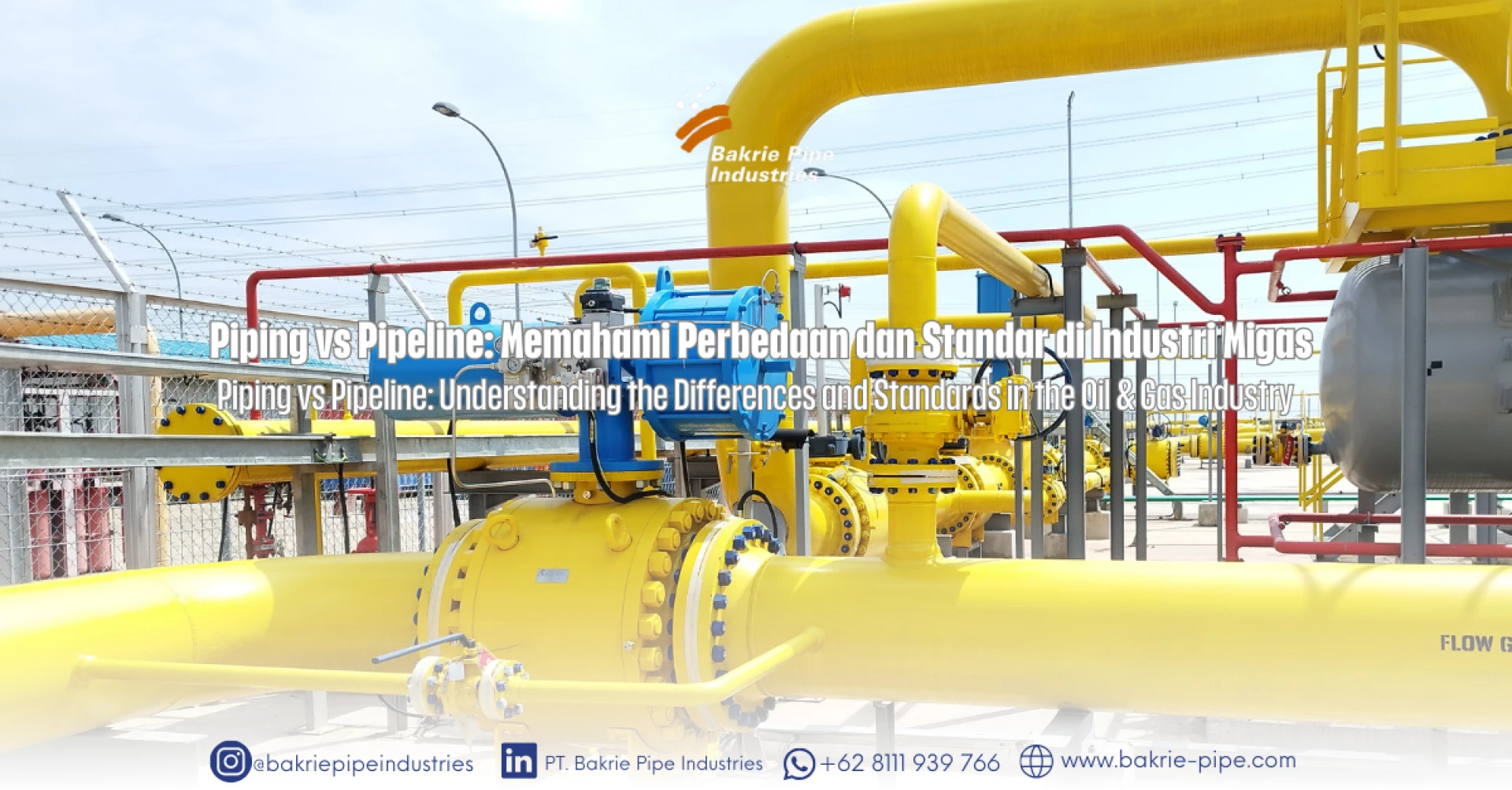
In the oil, gas, and industrial sectors, the terms piping and pipeline often sound similar and are sometimes confused. Yet, they have fundamental differences in function, location, complexity, and technical standards. This #BPIPipeInsights! article will help you understand the distinction between piping as a facility system and pipeline as a long-distance transportation system.
What Is Piping?
Piping refers to the network of pipes within industrial facilities such as refineries, processing stations, factories, power plants, or tank farms.
Characteristics of Piping:
Standards Applied:
What Is a Pipeline?
Pipeline refers to long-distance piping systems used to transport fluids from one location to another, such as:
Characteristics of Pipeline:
Key Focus Areas:
Standards Applied:
Quick Comparison
|
Element |
Piping (Facility Systems) |
Pipeline (Transportation Systems) |
|
Location |
Inside facilities (plants, refineries, power stations) |
Outside facilities (fields, cities, offshore) |
|
Distance |
Short, limited within one facility |
Very long, up to hundreds of kilometers |
|
Diameter |
Varies according to process needs |
Uniform, adjusted to flow capacity |
|
Valves & Fittings |
Numerous (valves, flanges, fittings |
Limited, mainly isolation valves |
|
Complexity |
High, with many components |
Lower, focused on transport efficiency |
|
Corrosion Protection |
Important |
Critical |
|
Main Standards |
ASME B31.1 / B31.3, ASTM, ANSI |
ASME B31.4 / B31.8, API 5L, ISO 3183, DNV, NACE |
Conclusion
Understanding the differences between piping and pipeline is crucial in planning oil & gas projects and industrial infrastructure. Piping is the internal system within facilities, while pipeline is the long-distance transportation system. Both use steel pipes, but with different standards and characteristics.
Bakrie Pipe Industries is ready to support steel pipe requirements for both systems, whether for industrial facilities or long-distance distribution of oil, gas, steam, and chemical liquids, with products that meet international standards and project needs.
Stay tuned for the next #BPIPipeInsights! article. If you require steel pipes according to the standards discussed, please contact our Marketing or Sales team, who are ready to assist you.
[Click here to contact WhatsApp Marketing & Sales]